Natural History Museum of Zimbabwe

Natural History Museum of Zimbabwe
Museums are for both education and entertainment or ‘edutainment!’ They offer scope for both formal and informal learning.
The Natural History Museum and its sites in the Western Region are a superb teaching aid for all levels of education.
Most of the displays in the galleries highlight many aspects in the syllabus of primary and secondary as well as tertiary institutions.
We always have activities such as structured visits by the schools with prepared study sheets for use during these visits, as well as conducting outreach programs thereby taking the museum to the people.
As a link between the museum and formal education, the department organizes an annual Primary Schools Heritage Education Quiz which runs from January to 18 May (International Museums Day). All primary schools are encouraged to participate in this quiz as questions asked are relevant to their syllabus. Schools are invited for participation through their districts which then cascade information to them.
The education department also helps in enhancing the understanding of collections to the visiting public through Tour Guides, Curators and the Heritage education tours. By so doing the department promotes the understanding of historical, natural and cultural heritage.
We are also involved in training of the staff and volunteers.
In July 2025, Zimbabwe hosted the 15th Conference of the Ramsar Convention. The Convention’s mission is “the conservation and wise use of all wetlands through local and national actions and international cooperation, as a contribution towards achieving sustainable development throughout the world”.
This is a particularly good time to draw the attention of Zimbabwean authorities and our people, to the crucial nature of wetlands for supporting biodiversity and water supply.
The Natural History Museum in Bulawayo organised an exhibition of the functions of wetlands to coincide with the Ramsar Convention.
This involved a giant (8 m x 2 m) ‘poster’ mounted on poles outside the Museum, in an area that lends itself to the creation of a working model of a wetland.
The artwork on the boards was developed in Harare by an artist there and the side panels were done by a Bulawayo designer.
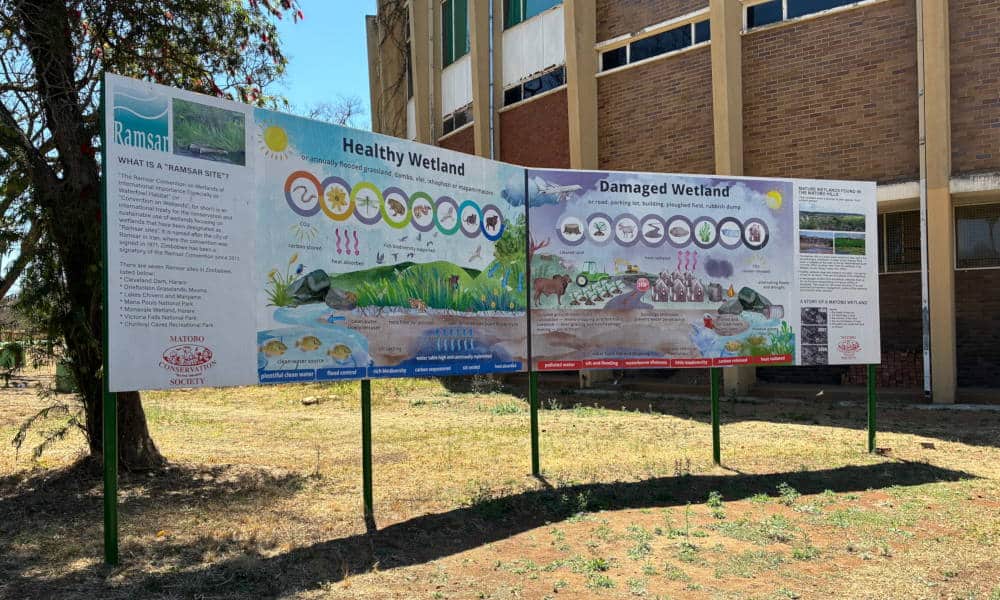
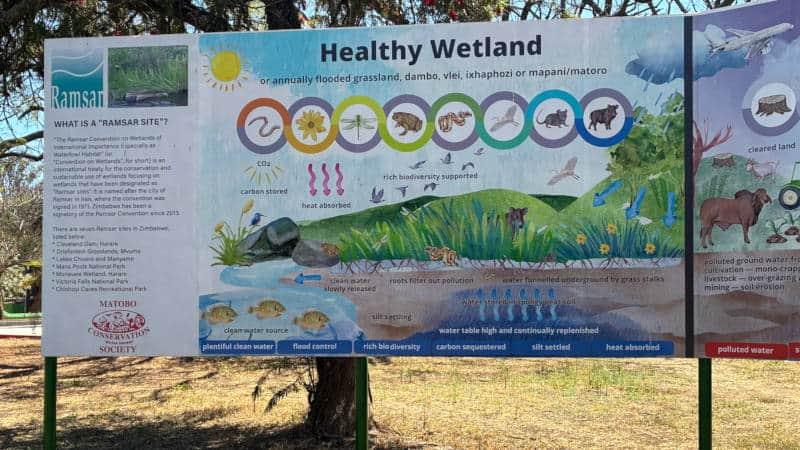
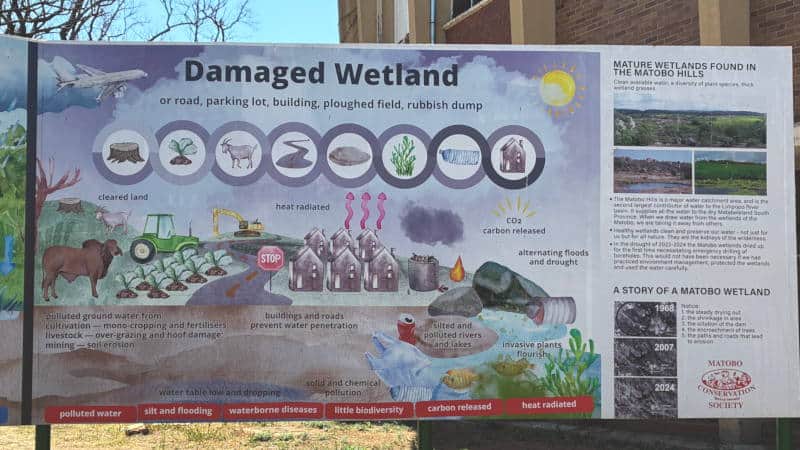
The poster-board, highlights the many positives of a healthy wetland and the negatives of a damaged wetland.
The side panels explain the specific importance of the Matobo Wetlands and the concept of a ‘Ramsar site’.
The Official Opening of the Project was on the blistery cold day of Saturday 19th July 2025 and since then much progress has been made.
The actual Wetland is a short way to the left of the above image, well away from the Museum building. The aim to harvest rainwater from half of the Museum roof has been successfully completed by Kordelle Construction, and is at the right of the poster-board.
During a rain-storm, water off the roof is collected along a V-drain surrounding the western side of the building and flows through underground concrete pipes into the Wetland. The water that ‘floods’ the lower level inside the Museum is pumped out and directed into the same piping system. The water in the large Council storm-drain that ultimately runs through the Centenary Park is not collected due to the polluted run-off from the roads.
The aim is to keep our Wetland as natural as possible. The recent wet season filled the ‘pond’ and lasted for a long time, attracting several species of dragon-fly and many birds. One previous Work Day involved volunteers throwing seed-balls over the area and this effort subsequently brought in many species of sedges and other wetland plants.
Thank you to all those who practised their bowling skills!
The next urgent priority is the construction of the Education Platform. A quote of US$6270 has been received from Ishmael’s Construction which includes a generous reduction of US$950, should their quote be accepted. One donation of US$1000 has already been received towards this work.
The level of the ‘pond’ area is to be raised and two loads of clay have already been donated and delivered by Scorpion Earthmovers. This will be spread out and once the first rains have come, the edges will be re-sealed. More seeds will be distributed and wetland plants sourced for transplanting.
To maintain the wetness of the Wetland during the cool-dry season, Forster Irrigation has suggested a plan involving the Council resuscitated borehole. This will be initiated as soon as funds become available.
Another aspect is the provision of benches and tables, under shade of indigenous trees up the slope from the Wetland and into the Miombo Woodland (still in progress). These will provide space for school-children to enjoy their Outdoor Classroom.
With this extra facility will come the placing of five free-standing educational posters along a walk-way indicated and lined with treated gum poles.
This update is to assure you that we are quietly and slowly working in the background to make this all happen. The Wetland Team thank their supporters for their generous donations in cash or kind:
We also acknowledge the support of Bulawayo City Council and their staff along with the many Volunteers.
Should you wish to offer a contribution, however big or small, towards The Museum Wetland Education Project, please contact Mthokozisi Moyo or Cathy Sharp in Bulawayo or Paddy Pacey in Harare and we will provide relevant details if you want to make a cash donation or a bank deposit.
We will acknowledge your support by printing your name on the Donor Board.
Mthokozisi Moyo (Project Manager) – (0783-298789) mthokozisimzi20@gmail.com
Cathy Sharp (Research Associate, Natural History Museum) – (0772-347135) mycofreedom@gmail.com
Paddy Pacey (Educational Consultant) – (0773-821086) paddy.pacey52@gmail.com

Please subscribe and be kept up to date as to what is happening at the museum. We have events that cover the following:


